
How to Search for Jefferson Parish Warrants
The Sheriff's Office does not post a public active-warrant search page. That means there is no online form where you type a name and see open warrants. Instead, warrant data turns up in a few places. The inmate roster shows fugitive, attachment, and probation-violation charge lines for people already in custody. Court files in JeffNet can show warrant-related entries. The Sheriff's records desk holds the official warrant records.
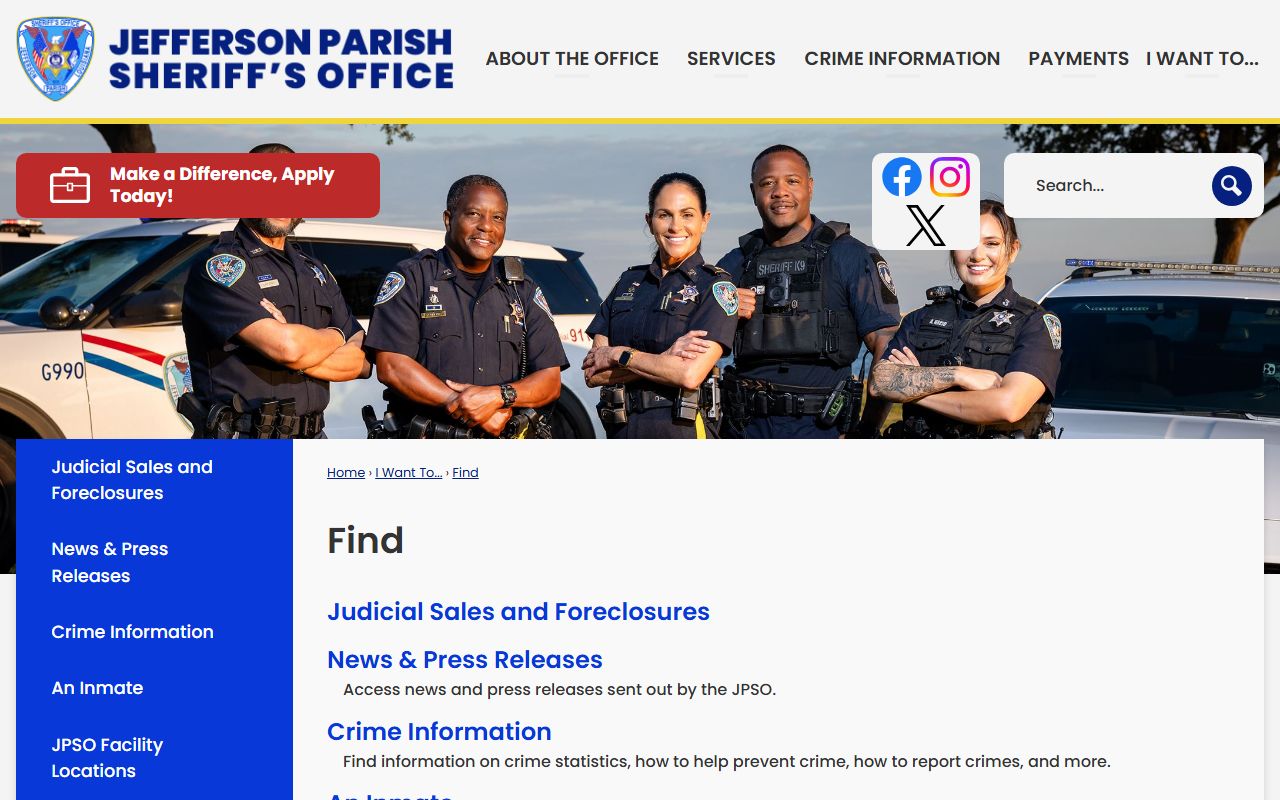
The Sheriff's "find" page links the inmate search, the sex offender registry, and other tools in one spot.
The official JPSO find page is shown below.
Because there is no open warrant portal, the safest checks run through official channels rather than third-party sites.
- Check the inmate roster for fugitive or attachment charge lines.
- Search court records in JeffNet for warrant-related entries.
- Contact the Sheriff's Central Records and Warrants Division.
- Talk to an attorney or the public defender before turning yourself in.
- Review bond options if a warrant is confirmed.
Central Records and Warrants Custodian
The Sheriff names a specific custodian for records and warrants. A clear, written request to that office is the formal way to ask about a warrant record. The custodian can also direct you to the right court when a matter is judicial rather than law-enforcement.
JPSO Central Records & Warrants
Cherie' W. Blanchard, Commander
1233 Westbank Expressway, Building A
Harvey, LA 70058
504-363-5591
Fax 504-363-5594
The Jefferson Parish public records page explains how to write the request.
Types of Warrants and Court Process
Several kinds of orders fall under the word "warrant" in Jefferson Parish. Some come from a judge, and some from law enforcement. The terms below show up in court files and on the inmate roster.
- Fugitive
- A hold for a person wanted on another jurisdiction's warrant.
- Attachment
- A Louisiana term for an arrest order, often tied to a missed court date.
- Bench warrant / capias
- A judge's order to arrest, usually for a missed appearance or contempt.
- Probation violation
- An order tied to breaking the terms of probation.
- Search warrant
- A court order to search a place, often sealed while a case is active.
Warrants and Attachments in Inmate Results
The clearest public sign of a warrant is a charge line in the inmate roster. When a person is booked, the roster lists the codes behind the hold. These codes follow Louisiana law and the parish's own labels. The table shows the warrant-related codes that appear in roster results.
| Code / Label | What It Shows |
|---|---|
| RS14:000 FUGITIVE | A hold for another jurisdiction's warrant. |
| ATTACH - MUN OR TRAFFIC ATTACHMENT | An attachment, often for a missed municipal or traffic date. |
| ART899 VIOLATION OF PROBATION | A probation-violation hold. |
| CCRP-890 SENTENCE IMPOSED | A sentence-related custody entry. |
These lines appear only after a person is in custody, so they confirm a warrant rather than search for one. The inmate records page shows how to read the full result.
Bench Warrants and Missed Court Dates
A bench warrant comes straight from a judge. The most common cause is a missed court date. In the 24th JDC, the virtual court instructions warn that failing to appear on time, or leaving before a case is called, can lead to an attachment for arrest. The same risk applies to in-person dates.
If you miss a date, do not wait for an arrest. Contact your attorney or the court to ask how to clear the matter. Acting fast often means the court can reset the date rather than hold you. A bench warrant does not expire on its own, so it can sit open for years and surface at a traffic stop or a background check. The sooner it is addressed, the fewer surprises later.
Note: A missed Jefferson Parish court date can trigger an attachment for arrest, so contact the court or your attorney right away.
Bond on a Warrant
Many warrants carry a bond, which is the amount needed for release once a person is taken into custody. The 24th JDC Criminal Commissioners set bonds, and one is on call around the clock. They use a bond range chart that weighs the charge and the person's history.
The four bond paths are the same as for any arrest. Cash bail is the full amount in a cashier's check or money order. A surety bond uses a bondsman. A property bond pledges real estate. Release on own recognizance is a promise to return. The inmate records page covers the booking and bond process in detail.
How to Resolve an Outstanding Warrant
Handling a warrant the right way protects your rights. Do not rely on third-party people-search sites, which are often wrong and not official. Work through the courts, the Sheriff, and counsel instead.
- Confirm the warrant through official court records or the Sheriff, not a private site.
- If you are already in custody, use the inmate search to see the charges and bond.
- Contact an attorney, or the public defender if you cannot afford one.
- Review the bond type that applies, since cash, surety, property, and recognizance differ.
- Request the official record from JPSO Central Records or the court custodian.
Public Records Requests for Warrant Information
Some warrant records are public, and some are not. Search warrants tied to an active case are usually sealed under law-enforcement exemptions. Other warrant records can be requested through the proper custodian. The right office depends on whether the matter is a law-enforcement record or a court record.
For Sheriff records, write to the Central Records and Warrants custodian. For court-issued orders, ask the Clerk of Court or the 24th JDC Judicial Administrator, who reports the status of a request within three days. Be specific about what you want, since a vague request slows things down.
- Sheriff warrant records, through JPSO Central Records and Warrants.
- Court-issued orders, through the Clerk or the Judicial Administrator.
- Active search warrants, usually withheld while the case is open.
Louisiana's Public Records Law sets the framework, which the public records page covers in full.
Why Third-Party Warrant Sites Are Risky
Many private sites claim to run a Jefferson Parish warrant search. They are not official, and their data is often old or wrong. A site may show a warrant that has been cleared, or miss one that is active. Acting on that data can cause real harm, from a wasted trip to a bad legal move.
Stick to the courts and the Sheriff. This site is not a government agency, and the information here cannot be used for credit, employment, tenant, or insurance screening. For a warrant, the official record is the only one that counts.
Attorney and Public Defender Role
A lawyer can confirm a warrant, arrange a surrender, and ask for a bond. People who cannot afford counsel can use Louisiana Public Defender District 24, which covers the whole parish from its Gretna office at 848 2nd Street, phone 504-364-2824. Having counsel before you act on a warrant often leads to a better outcome.
The Jefferson Parish arrest records page has more on the District Attorney and the defender's role after an arrest.